
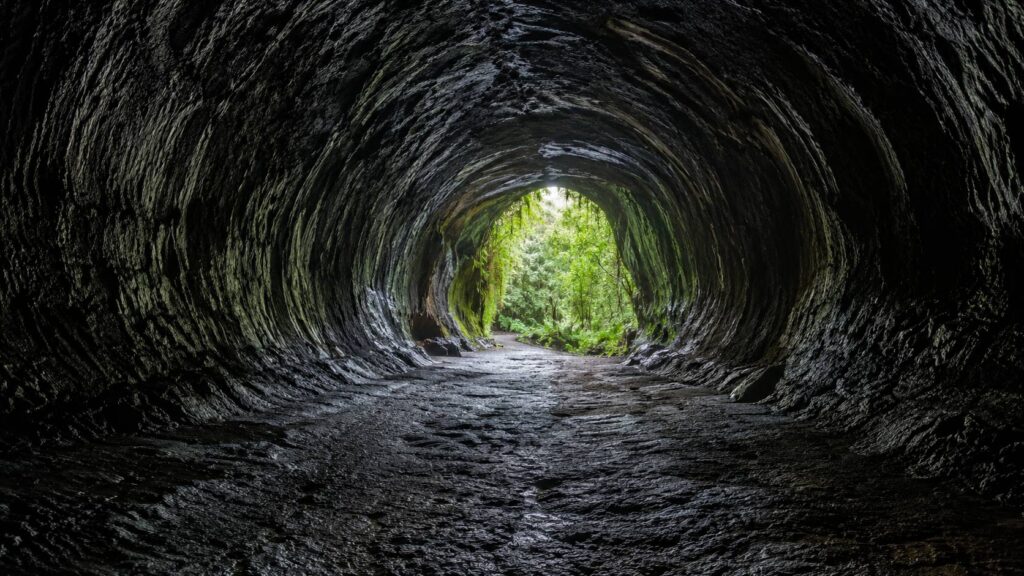
Nature’s Tunnels Beneath the Volcano
One of the most surprising stops in Hawaii Volcanoes National Park is the moment you walk straight into the earth through a tunnel carved by molten rock. These natural tunnels are called lava tubes, and they are one of the coolest ways to understand how a volcano actually builds the land. If you have ever wondered what a lava tube is and how one forms, here is a simple look at these hidden wonders of Kilauea.
What Exactly Is a Lava Tube
A lava tube is a natural tunnel left behind by a river of flowing lava. When a volcano like Kilauea erupts, lava can pour downhill in long streams. The outer surface of that stream cools and hardens into a crust while the lava underneath stays hot and keeps moving. Over time this creates a roofed-over channel with molten rock still rushing through the middle. When the eruption slows and the lava drains away, it leaves a hollow tunnel behind. That empty tunnel is the lava tube you can later walk through.
How a Lava Tube Forms
The process sounds complicated, but it comes down to a few natural steps. It all starts with a smooth, fast-moving type of lava that Hawaiians call pahoehoe, which flows easily and cools into a ropey surface.
- Lava streams downhill and its top surface cools into a hard crust.
- That crust acts like a roof, insulating the hot lava flowing beneath it.
- Protected from the air, the lava inside stays molten and keeps moving for long distances.
- When the supply of lava stops, the tunnel drains and a hollow tube is left behind.
The same insulation that keeps the lava hot is why these tubes can carry lava for miles, and why the tunnels they leave can be surprisingly long and tall.
Walking Through Nahuku
The most famous lava tube in the park is Nahuku, often called the Thurston Lava Tube. Formed centuries ago, it sits in a pocket of lush rainforest, so you walk through a curtain of green ferns to reach it, step down into the cool tunnel, and come out the other side back into the forest. It is an easy, family-friendly walk and one of the best ways to feel the scale of what the volcano can create. Inside it stays cool and damp, so a light layer helps, and the ground can be uneven and dim.
Why Lava Tubes Matter in Hawaii
Lava tubes are more than a fun photo stop. They are a living record of how these islands were built, layer by layer, flow by flow. In old Hawaii, lava tubes served as shelter, as sources of fresh water, and as places of deep cultural meaning, part of the living landscape shaped by Pele. Many tubes are also home to rare insects and delicate features, which is why it is important to stay on marked paths and treat every tunnel with respect.
See a Lava Tube for Yourself
Standing inside a tunnel once filled with molten rock is the kind of thing you never forget. Our Lava Tube and Rainforest Tour is built around exactly this experience, pairing a walk through the tube with the lush native forest that surrounds it, while our Crater Rim and Steam Vents Tour adds the park’s famous overlooks. Because the volcano is always changing, check current park alerts before you visit, come with sturdy shoes and a light layer, and get ready to walk straight through the heart of Kilauea’s history.